| |
|

Li Deshui(C), Commissioner of the National Bureau of Statistics (NBS), speaks at a press conference held by China's State Council Information Office in Beijing, capital of China, Dec. 20, 2005. [Photo: STATS.gov.cn]
|
|
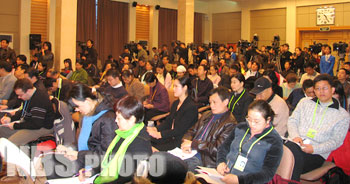
A press conference on the results of the first national economic census was held by China's State Council Information Office in Beijing, capital of China, Dec. 20, 2005. [Photo: STATS.gov.cn]
|
The country's top statistician Li Deshui briefs the achievements of the first national economic census and changes of China's GDP aggregates and its structure at a press conference of the Information Office of the State Council in Beijing on Tuesday.
Key Achievements of the First National Economic Census with New Changes of China's GDP Aggregates and its Structure
National Bureau of Statistics of China
Li Deshui, Commissioner of the National Bureau of Statistics
20 December 2005
I am going to present today a briefing on the key results of the First National Economic Census, and in particular, the GDP figures for the year 2004 based on the census results, as well as data use.
I. Main Characters of Economic Census
On July 2003, the State Council decided to conduct the first national economic census in 2004 by combining the former industrial census, the tertiary industry census and establishment census, and including in the economic census the construction sector. Its main purpose is to meet the needs of economic and social development, to better link up with the National Five-Year program and to push forward the comprehensive reform of national economic accounting system and statistical survey system. The reference time for the census was December 31st of 2004, and the flow data covered the whole year of 2004. The economic census covered all legal person units, establishments and self-employed individuals who were engage in the secondary and tertiary industries within the territory of China. With the joint efforts from governments and departments at all levels over the last two years, the major tasks of the census have been completed successfully. The following tasks have been fulfilled:
Setting up census organization and recruiting enumerators. The Leading Group of the First National Economic Census was set up under the State Council, with Zeng Peiyan, Vice Premier of the State Council, as the head, and its Office located at the National Bureau of Statistics. Governments at all levels and concerned departments also set up corresponding leading groups and organizations. Over 3 million as enumerators and supervisors were recruited, and another 10 million statistician and accountants from government agencies, enterprises and institutions were mobilized to participate in the census.
Formulating census program and launching publicity campaign. In line with the real situation in China and taking the experiences of other countries as reference, the census program was formulated after a series of consultations made at governments and departments at all levels, among experts, scholars and respondents, and after completion of pilot censuses. Central government and local governments at all levels appropriated special budget for the census. Census offices at different levels made use of different means to conduct extensive publicity and mobilization activities, so as to let all circles of the society and the public to fully understand the importance of the census.
Enacting census regulations and carrying out census according to law. The State Council promulgated the National Economic Census Regulations signed by Premier Wen Jiabao (No. 415 Decree of the State Council). A total of 5,337 cases were investigated involving providing false or incomplete data, or refusing to respond to the census. All these ensured the smooth conduct of the census.
Rigorously checking the census data and implementing post-census survey on data quality. Over 30 million questionnaires (not including those from individual households) were collected in the census with more than 1.06 billion records of first-hand raw data. Provincial offices submitted over 20,000 aggregated tables. Strict quality control measures were adopted at each stage of the census to ensure the quality of data from the census. Results of the post-census sample survey showed that the comprehensive reporting error was only 4.9 per thousand, within the 1-percent target.
In summary, the economic census proves that it is not only an important survey on national conditions and strength and a valuable practice of administration according to law, it is also a very useful fundamental work for implementing the scientific approach to development in an all round way. The economic census in general is successful. Abundance of detailed data are obtained which can truly reflect the achievements made and national strength gained since China adopted the reform and opening program.
II. Major Achievements of the Economic Census
1) Basic information was obtained on the real situation of the secondary and tertiary industries in China. Thanks to the economic census, we are in possession of rich basic information on the development of the secondary and tertiary industries. Key results were released to the public recently through Census Communiqués.
2) Development of registers and its databank system of establishments are taking shape. All the raw materials are now stored in economic census databank in the National Bureau of Statistics. It can produce not only national aggregates, but also detailed breakdowns such as data by region, by sector, by size of economic units and by ownership according to different needs for analysis and research. The National Bureau of Statistics is cooperating with the State Commission Office of Public Sector Reform, the Ministry of Civil Affairs, the State Administration of Taxation and the General Administration of Industry and Commerce in developing a system of updating the national registers of establishment.
3) The aggregated size of GDP and its share across industries was verified. Preliminary estimation using results from the economic census indicates that China's GDP for the year 2004 was 15,987.8 billion yuan at current prices, representing an increase of 2,300 billion yuan or 16.8 percent over the preliminary estimated figure using regular annual statistical data. Of this total, the share of the primary industry was still the figure from the annual preliminary estimation, as the primary industry was not covered in the census. The value-added of the primary industry was 2,095.6 billion, and its share in GDP was 13.1 percent, or 2.1 percentage points lower than its share of 15.2 percent as was calculated from the annual preliminary estimation. The value-added of the secondary industry was 7,390.4 billion yuan, or 151.7 billion more than that from the annual preliminary estimation, while its share in GDP shrank from 52.9 percent to 46.2 percent, a drop of 6.7 percentage points. The value-added of the tertiary industry was 6,501.8 billion yuan, or 2,129.7 billion more than that from the annual preliminary estimation, and its share in GDP rose from 31.9 percent to 40.7 percent, an increase of 8.8 percentage points. Of the total increase of 2,300 billion in GDP, the increase of the value-added for the tertiary industry accounted for 2,130 billion or 93 percent.
It is the significant under-coverage of the tertiary industry in the regular statistics that lead to the above situation. Firstly, China had long being using the Material Product System (MPS) which was developed under the centrally-planned economic system in its national account statistics until 1980's, resulting in very weak statistics for the service sector. In 1990's, service statistics was enhanced along with the gradual integration of China's national account system with the international standards of the UN System of National Account (SNA). However, basic statistics need time to be built. Secondly, the scope of tertiary industry is wide and complex with large number of units, which have no good means for accounting and statistics. Thirdly, along with the economic reform, China has seen a diversified economic development in terms of ownership, and in particular, a dynamic development of private and individual-run service activities. It is very difficult to conduct statistical surveys as they are very scattered with frequent changes, resulting in certain degree of under-coverage. For instance, for the 3 sectors of transport, storage, post and telecommunications; wholesale and retail trade, catering trade; and real estate, where private and individual ownership have taken a large share, the value-added was about 1,500 billion yuan larger than that from the regular statistical programs, accounting for 70 percent of the total increase of the tertiary industry. Fourthly, while many new services are mushrooming, data on their activities are often under-estimated, as they do not have necessary records for our regular statistics programs to make accurate account. For instance, recent years have seen rapid development of computer service, software, internet service and satellite data transmission, recreation, leasing, business services and household services. We have made estimation with related information in our regular statistics, yet they are far from adequate. Fifthly, some of the services affiliated to manufacturing or construction enterprises are estimated but classified into the secondary industry, while more others are neglected. The economic census helped to verify and make up the service activities that were not covered before, so that the structure of the three industries are more consistent with the actual situation in China and more in line with the general level of developing countries. Although the revision leads to some increase in the total size of GDP, the ranking of China's per capita GDP is still beyond 100 in the world.
Provincial statistical bureaus also calculated provincial GDP estimates on basis of establishment data from the census and by using standardized compilation approaches developed by NBS. A joint review was conducted by NBS on the provincial estimates, which showed that the total of provincial estimates were close to the estimates of national GDP aggregates, and so was the structure for the three industries. Through the census, we are able to remove the "water" from the statistics of the manufacturing sector, in particular, from small size enterprises, that was accumulated from the past in some provinces, and to include that part of the value-added of the tertiary industry that was not covered by regular statistics programs. As a result, the total size and the structure of provincial GDP also changed. The economic census also contributes to reconciling basic data for national and provincial GDP compilation, standardizing accounting system and methodology, and promoting more scientific approach for statistical work on legal and standard basis. Statistical agencies are making efforts to improve service statistics and statistical surveys on small economic activities by summing up our past experience.
In order to ensure the comparability of GDP data over time, it is necessary to revise historical data in line with international practices. At present, NBS is working on the revision of data back to 1993 on the basis of revised GDP figures in the census year, using the trend deviation method which is widely adopted by the Organization for Economic Co-operation and Development (OECD). Results of the revision will be released on another occasion.
According to the decision by the State Council, the census results will be used as a basis for the central government (including ministries) and for local governments in compiling 2005 national account statistics, in highlighting economic and social development for the 10th 5-year plan period, and in preparing the 11th 5-year development program and the 2006 annual development plan.
In the publication, utilization and analysis of the census results, departments and local governments concerned should continue to abide by the Statistics Law and the Regulations on National Economic Census, to protect business confidentiality and privacy of respondents, and to honor earnestly the commitments of not levying any penalties on respondents on the basis of census information. |
|